
DevComm
Still on Air: Radio in the AI Era
R
Rheana Guirindola
Feb 15, 2026
4
5
9
10
16
The Origins
World Radio Day began in 2010 after it was proposed by the Spanish Radio Academy and was officially approved by UNESCO in 2011. It was first celebrated worldwide in 2012 and is observed every February 13 to mark the founding of United Nations Radio in 1946. The day was created to recognize radio not just as a broadcasting tool, but as a powerful platform for education, cultural expression, and civic engagement. It honors radio’s lasting importance and its ability to adapt in a constantly changing digital world. Over the years, it has gained global recognition, bringing together broadcasters, listeners, and communities to celebrate radio’s role in connecting people across cultures and continents. UNESCO also encourages active participation each year, highlighting radio’s unique ability to reach even the most remote and underserved communities.
A Catalyst for Development
Radio remains highly relevant in development communication in the Philippines because of its accessibility, resilience, interactivity, and cost-effectiveness. Although internet use has grown, with about 83.8% of the population online as of late 2025, radio continues to reach a vast audience. According to older data from the National Commission on Culture and the Arts (NCCA), 85% of the country’s 12 million households own a radio set, making it a reliable source of news and information even in areas where internet access is limited or unstable. Radio proves especially valuable in emergencies when other communication systems fail, as it can deliver timely updates and safety instructions during disasters in a country prone to typhoons, earthquakes, and floods. Community and local stations like the Radyo Natin network with over 100 radio stations across the country serve as platforms for dialogue, allowing listeners to engage, respond, and participate in discussions that influence local development and social awareness. Moreover, radio is highly cost-effective, allowing development programs to reach large numbers of people at a fraction of the cost required for digital campaigns, making it an ideal platform for public health initiatives, agricultural advice, and civic education throughout the Philippines.
Aligning with Sustainable Development Goals
Every year, World Radio Day is celebrated with a theme that highlights urgent global issues, demonstrating how radio continues to respond to contemporary challenges. Previous themes have included “Radio and Diversity” in 2020, which promoted inclusive representation; “Radio and Trust” in 2022, which addressed misinformation during the pandemic; and “Radio and Peace” in 2023–2024, emphasizing the medium’s role in reconciliation and conflict resolution. The theme for 2026, “Radio and Artificial Intelligence,” explores how radio can adapt to technological innovations while maintaining credibility, human connection, and community engagement. These annual themes show how radio aligns with the United Nations Sustainable Development Goals (SDGs), ranging from SDG 2 (Zero Hunger) and SDG 3 (Good Health and Well-being), SDG 4 (Quality Education) to SDG 5 (Gender Equality), SDG 10 (Reduced Inequalities), and SDG 16 (Peace, Justice, and Strong Institutions).
Radio in the Modern World
Radio is not a thing of the past. Today, it is combined with digital tools like SMS polls, WhatsApp groups, and community listening sessions to reach more people and keep communities engaged. Supporting community radio through training, funding, and policies is important, as many stations work with limited resources but play a vital role in local resilience and democracy. As World Radio Day 2026 approaches, it reminds us that using proven tools wisely is key. With over 3 billion people still offline according to International Telecommunication Union, 2025, radio continues to ensure that development reaches everyone.
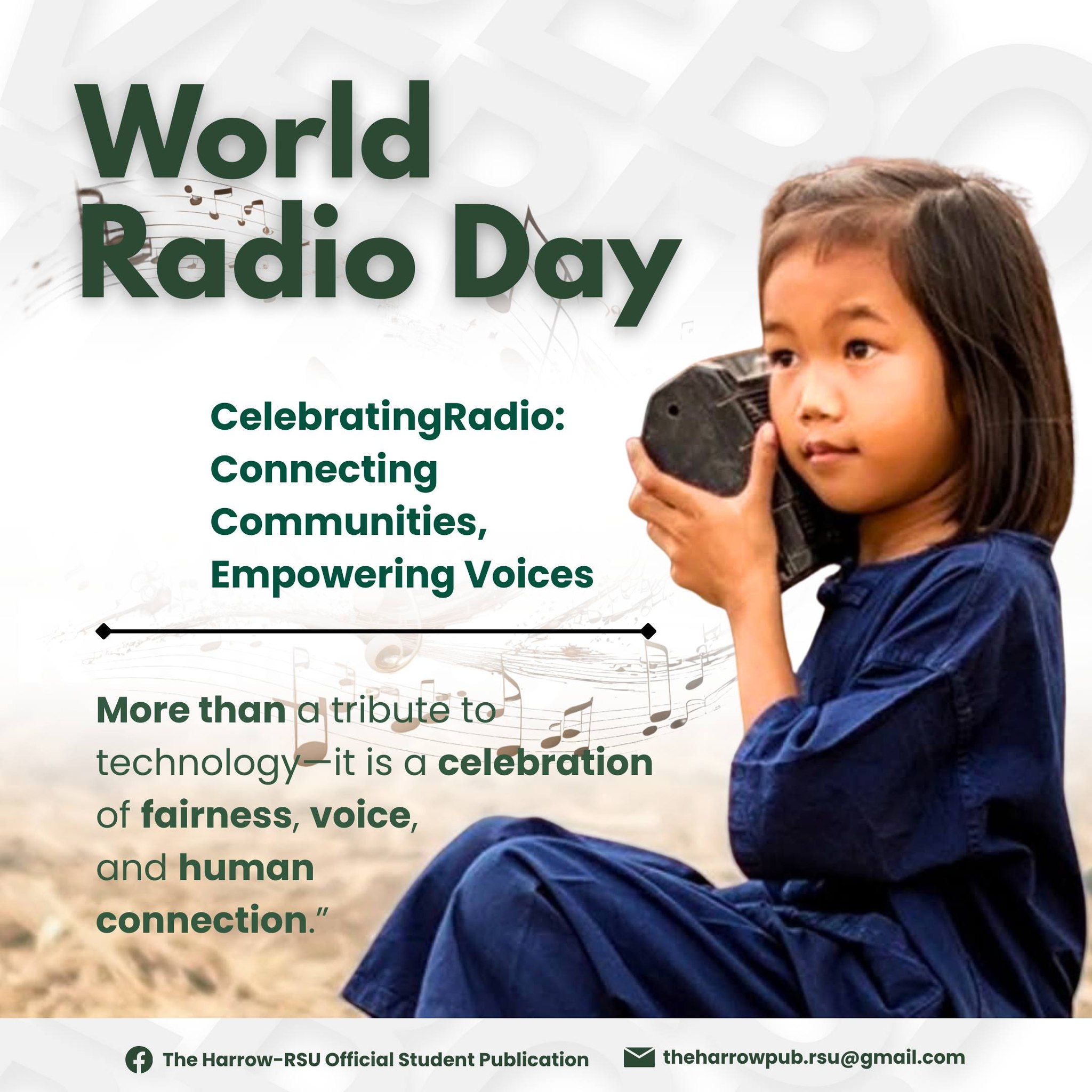
World Radio Day is more than a tribute to technology—it is a celebration of fairness, voice, and human connection. Radio makes information accessible to all, gives a platform to those who are often unheard, and bridges gaps in ways that algorithms alone cannot achieve. As UNESCO puts it, “Radio is you.” It reflects the lives of communities, responds to their needs, and amplifies their dreams. For truly inclusive and sustainable development, radio is not just relevant—it is essential. On February 13, 2026, we honor this powerful medium and reaffirm our commitment to using it to serve the common good.
// words by Rheana Guirindola
// layout by Jander Rosh Narsoles and Mark Andrew Fabella
References:
Kemp, S. (2025, February 25). Digital 2025: The Philippines — DataReportal – Global Digital Insights. DataReportal – Global Digital Insights. https://datareportal.com/reports/digital-2025-philippines
Radio: UNESCO’s enduring commitment to information and communication. (2024, March 11). https://www.unesco.org/.../radio-unescos-enduring...
Radyo Natin | Home. (n.d.). Radyo Natin. https://radyonatinfm.com/
Sibthorpe, C. (2026, January 7). Why are 3.4 billion people still offline? Devex. https://www.devex.com/.../why-are-3-4-billion-people...
United Nations. (n.d.). World Radio Day | United Nations. https://www.un.org/en/observances/radio-day
World Radio Day 2026. (2026, January 9). Sustainable Development Goals - Resource Centre. https://sdgresources.relx.com/events/world-radio-day
Yumpu.com. (n.d.). The Philippines - Infoasaid. yumpu.com. https://www.yumpu.com/.../10381128/the-philippines-infoasaid
END OF STORY